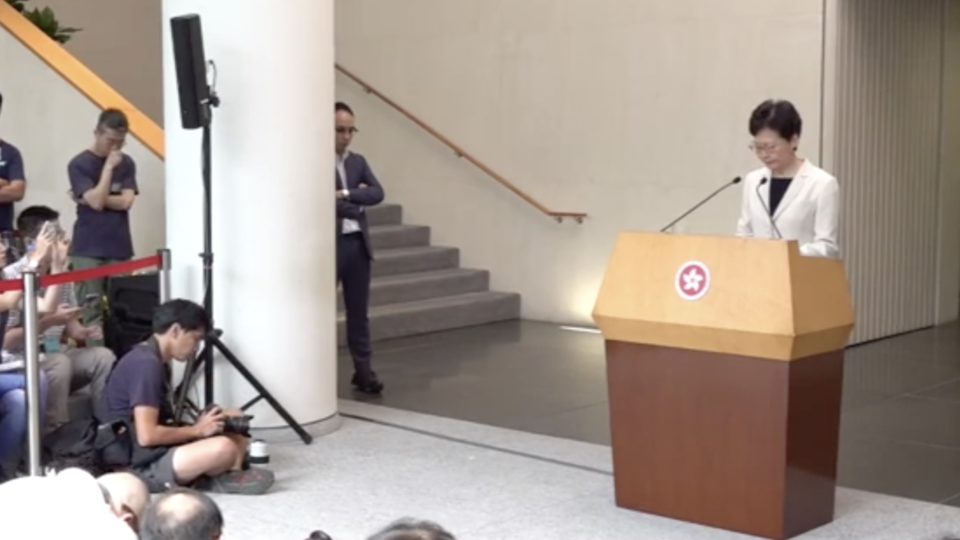

Hong Kong鈥檚 political impasse is one of Beijing鈥檚 making, with the central government effectively hamstringing Chief Executive Carrie Lam by forbidding her from making any concessions to protesters, according to an exclusive report from Reuters.
The story, published today and based largely on anonymous sources, said that at some point prior to Aug. 7 assessing the protesters鈥� demands and suggesting that two 鈥� withdrawing the extradition bill that first sparked the movement and launching an inquiry into the unrest 鈥� were politically feasible and might restore calm.
Beijing, however, slammed the door on the suggestion, according to a senior Hong Kong official, and also shot down the other three demands on the table, which included legal amnesty for arrested protesters, the retraction of the characterization of protests as 鈥渞iots,鈥� and genuine universal suffrage.
鈥淭hey said no鈥� to all five demands, said another source with close ties to the Hong Kong government. 鈥淭he situation is far more complicated than most people realize.鈥�
A third source, identified as a senior Chinese official, said that not only had Beijing rejected the demands, it faulted Lam鈥檚 administration for not taking more initiative.
In a statement to Reuters, Lam鈥檚 office said the government had tried to address protesters鈥� demands, but sidestepped the question of whether they had submitted the report or received instructions from Beijing.
Lam has also refused to answer the question publicly, including in a testy exchange with a Reuters journalist during a heated press conference earlier this month in which the reporter pointedly asked whether Lam had the 鈥渁utonomy to decide to withdraw the bill.

鈥淚n other words, have your hands been tied by Beijing鈥� or is this a point of political pride on your part?鈥� the reporter added.
As Lam began by insisting that she had answered the question before, rather than offer a simple yes or no, the reporter pressed again, saying she had 鈥渆vaded this question on numerous occasions.鈥�
As Lam again began to offer an explanation echoing the central government鈥檚 stance that it still had faith in her administration, the reporter interjected again, insisting that she answer the question.
A moderator finally interceded, but the back and forth continued, and Lam finally concluded the exchange, firmly stating, 鈥淚 have already answered the question,鈥� though in fact, she had not.
The report, if accurate, sheds light on the extent to which Beijing is the ultimate arbiter of Hong Kong policy-making, even in spite of the city鈥檚 high degree of autonomy under the 鈥渙ne country, two systems鈥� framework.
It also raises questions as to how the city will navigate its way out of the worst political crisis in decades if neither side is willing 鈥� or able 鈥� to give ground.


